Is being frugal a gift of the Holy Spirit?

I’ve been guided my entire life by the understanding that there are gifts to be received from the Holy Spirit. When I was a classroom teacher I had a display board in my room that highlighted these gifts.

Somewhere along the way, I lacked Counsel, Wisdom and Knowledge. I did not go down the path of making wise financial decisions. Instead, I was wasteful with money. I lacked Wisdom and Knowledge as well.

So if being frugal is in fact a virtue, I don’t have it. It’s not a gift I have been given and it’s clearly not something anyone taught me.

I worked hard. I was obedient and I certainly had a fear of the Lord. I have an abundance of fortitude and a very deep ability to understand. And I have a very clear ability to love and serve God. I’ve never thought of money as a God, nor do I honor money. My days are spent trying to serve God, so my lack of money wisdom could just be works of evil that crept in or behaviors related to my childhood or experiences throughout my adulthood. I simply have no descent explanation for any of it other than stupidity.
Frugality Reality

In Clare Levison’s book, Frugal Isn’t Cheap, she recalls how her father instilled frugality in her from a very young age. “It’s the family way,” Clare states.

My Childhood Frugality Stories

Who in my past instilled frugality in me? The instillation of the act or virtue of being frugal might come from a family cultural lifestyle descending from hardworking grandparents. My earliest memories of how others were frugal are not any deep rooted events, memories, or even lectures but merely a way of living. Perhaps then if frugality is observed and not taught it might transform itself into an alternative lifestyle as an adult. My grandfather Henry, was a real stickler about proper etiquette and cleaning the food off your plate. My grandfather Julius simply worked hard and I recall visiting him to get shoes at his shoe store. He always seemed to look nice but seem to wear the same sort of things. My grandfather Henry also always looked nice but seemed to be wealthier. So who was frugal? I observed my grandmother Vogler with lots of beautiful laces and trims for her doll clothes business. In fact, she had a mini store of laces and trims in white plastic cases. My grandma Irene just took care of her nine children by cooking and talking to them. When she gave me a Christmas gift it was something small and practical like shampoo. Shampoos were actually considered a luxury back then. Until her death I received no more than $5.00 as a gift. Family gatherings were a big deal with nine children, spouses and grandchildren and were always Dutch style. Every family brought a contribution to the holiday gatherings. The meat was usually taken care of by my grandparents, I think.

My mother canned. My father fished, gardened and hunted for our food. Frugal was about living within your means, using your resources wisely and not having extravagant things. If it wasn’t homemade we didn’t have it. Shopping wasn’t something you did in the early and late 1960’s when I was a little girl. We were not a family to complain. I never saw anyone ever ask for money from anyone. Borrowing things also was never observed so I am thinking what was instilled is not frugality so much as it is if you didn’t have it or need it you learned to do without. I think that you s the behavior instilled in me, “learn and accept with joy to do without.”

Frugal Child Turns Into Squandering Adult

I was raised to be a frugal child. We were what current standards define as poor thus we found creative ways to use our resources wisely. I did not get to have trending toys or clothes growing up in the mid 60’s. My parents drove an old brownish rusty Studebaker. We had a backyard garden, a swing set and a sandbox to play with. I once confessed to a banana stabbing crime I did not commit just to get a dime. Susan Ragolia, in the edited book, The Frugal Woman’s Guide to a Rich Life, defines frugal as someone who is the mother of creativity. Frugal is getting the most for your money,”

Growing up I watched my parents get the mist for their money. This meant buying groceries prudently and on a strict cash only grocery store budget. For entertainment we used free nature events to keep us busy and outdoors all the time. I loved going to Lake Michigan most of all and we always entered on a free entry point to the beach. We always recycled everything. I don’t recall having garbage or even a garbage can. My grandmother made all my clothes.

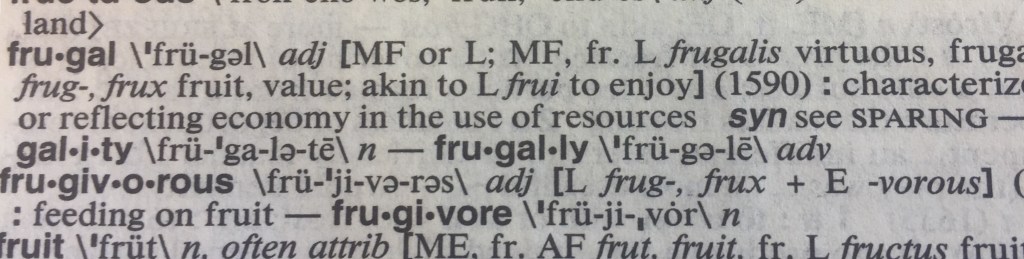
The Webster’s Dictionary defines frugal as an adjective derived from the French meaning virtuous and from Latin to enjoy. Around 1590 it began to define characteristics or reflecting economy in the use of resources. I think a lot about being virtuous but I never really thought about being frugal as a virtue. I think it really is a virtue to have and I’ve managed to lose sight of the virtue of ‘being frugal.’

What is interesting to think about is the derivative of the word from Latin to mean enjoy. You could make the claim that to be frugal is to find joy or enjoyment in nothingness. Joy is within and the virtue of frugality enables you to find joy within and not from external resources.

I’m going to look into these questions from a different perspective of virtue living styles and how the French did that. In the meantime, I am still at a loss of how to explain being a squandering adult given my virtuous childhood. I don’t know where this behavior went south or even why for that matter. And when told, “You’ll never change your behaviors. You’ll fall back into your old ways again.” How can I change? Why haven’t I changed back? When will I change? Can I change? What will it take to not change back? Those are all questions I think I need to resolve some how if I am going to change.

My Frugal Family Growing Up 1970

Helping others be Responsible Financial Stewards Through Wise Use Of Resources

One might not think about the wise use of individual talents and resources as being a responsible steward of God’s money but God gives us talents and gifts to use to serve him. Through a view that where I am now is sufficient is not good enough. God wants us to use all we have to serve and that includes our unique talents. That includes seeking out a better source of employment if necessary and to do it a way to receive financial gifts we are meant to have. It’s ok to seek a better job if we are qualified to do so. In my case, I’m going to do all I can to help my young adult seek the gifts she is meant to have. Gifts in the form form of financial stability. Seeking our gifts is necessary if we are to be good stewards of God’s money.

The Art Of Not Spending Money: 8 New Strategies

1. Selling Old Stuff: One really effective strategy I’ve discovered is taking time to clean and sell unwanted or unused items. This has really kept me busy. I’ve had to take time to find resale shops and sell the items or I’ve taken time to list items on eBay and LetGo. This time spent selling for cash has helped me think about the time I spent charging items. It’s been extremely exhilarating talking with people where I’m going too.

2. Teapot Cash Stash: I started a place where I put cash I earn rather than keep it in my purse and at the end of the week I opened a New Savings Account.

3. Reading Books on Money: I’ve learned a lot from reading books on money. It’s a good thing to educate yourself on topics like being frugal or a money cleanse theme.

4. Sing Praises to God: I’ve been stronger with my self-discipline and I’m grateful to God for moments of success.

5. Delete Amazon: I spoke with customer service on Amazon to help me successfully delete my account. This has kept me from pressing my Amazon link and ultimately from making Visa charges through Amazon.

6. Talk with a Friend: I know I have a fabric buying issue so I met with a friend who also sews and she gave me the ideas Of keeping a handwritten inventory of my sewing materials.

7. Go Credit Card Free: I removed my credit card and made zero charges on it. I’m only traveling with a debit card.

8. Establish a Set Amount: I signed up to get daily debit card balances and I discovered it has really helped to know I only have $140.00 to spend. Knowing each day this exact amount keeps me Money aware. Thus, I now try to keep that amount on the card.

Alerts Caused Me Stress

I can’t believe that getting alerts cause people anxiety and speaking to professionals about money makes others angry. When it comes to money, I’ve learned when money is your God, people become very angry about their money and the protection of it. How I suffer, is doing innocent inquiries to gain knowledge and alerts get sent. I suffer significantly in my level of anxiety. Why can’t I honestly and sincerely ask questions about money to learn without fallout. Now, this repeated pattern leaves me without emotional support and I don’t get why that is. Money is not my God. Jesus if you expect me to be a better steward of your money then you are going to have to remove money anxiety. I can’t do this on my own and I am so sick of being the recipient of anger in a way that escalates repeatedly to violent and emotional damage. I can’t handle it so make it stop or I can’t help you.

Destination Financial Frugalville, USA

I read this quote today doing my research on Investment Banking and it’s really a great goal setting quote.

Planning Trip to Frugalville 2020

1. My destination is to invest any money saved by not spending into a Gold ETF.

2. I have saved about $450.00 this week by not spending and I have budgeted enough for groceries and gas for the week. I’ve sold unwanted junk and other things to get rid of clutter and I’ve not spent any of that cash.

3. Now I am ready to chart a financial course rather than working in a deficit mode. I have changed the budget thinking from a month to a week to help me with smaller units of money measurements and more reachable short-term goals.

4. Seek strategies now on investment when you have really small amounts of money.

Just as you wouldn’t start a trip without a destination in mind, it’s nearly impossible to chart your financial course without a plan.

– Rich Ramassini, CFP®
Senior Vice President | PNC Investments